
I Hear You...Reading
A conversation about Los Angeles in prose with novelist Zachery Dillon.


I’ve just finished Case 4: The Case of the Legally Distinct Magic Castle, and in the bye week I wanted to do something different. Vibes Detective’s Agency is about friendship and ghost hunting and trying to recapture joy in your thirties, true, but it is also a love letter to Los Angeles. Where else could I set a story about a mathematician and a mystic hunting ghosts but a city where you can often find quantum physicists and quantum dynamic energy healers at the same party and sometimes sharing a tab of acid?
I’m not alone in writing about LA. For a city so young, it’s startling how many books are set here. That has always struck me as ironic, that a city that views itself as the motion picture capital of the world is so well represented in prose.
This week, I wanted to speak to another Substack writer—one of my personal favorites, in fact—who’s also set his novel in LA.
Zachary Dillon is the author of “I Hear You Watching”, an absolutely terrifying and occasionally hilarious book about a man whose life slowly begins to unravel as he becomes convinced he’s being followed and his every movement observed. It’s fiction but based on his personal experience hearing voices, and it’s a really, really—I’m totally serious—really good read.
Zach and I talk loneliness, hope, and the universal (in our opinion anyway) fear that you can never truly escape being observed. In other words, we talk about LA.
[This interview has been edited for length and clarity.]
A: Zach, I’m loving the book. It's so spooky. I'm not often scared willingly, but I’ve gotta keep going back to this. I gotta see what happens to this dude next.
Z: That's awesome. I remember the first time I described it to a friend of mine, beginning to end and his response was, “dude, that's terrifying”. I’d never really thought of those experiences as scary. I always thought of it as being just intrusive and annoying, but I was never afraid for my own life. I wished that something would happen because at least I'd have proof that the voices were real, you know. I’d have a black eye or a missing finger or I'd be dead.
I have had people say that they eventually had to stop reading it before bed because it was freaking them out.
A: So that gets us onto the topic at hand. LA is a big piece of the novel, right?
Z: I had to bend the truth a little bit in order to get at the truth. So there's a little bit of Glendale, a little bit of Studio City and a little bit of Burbank all kind of wrapped up together.
A: They all kind of bleed into each other, to be honest. Though I think Glendale is a very underrated part of Los Angeles1.
I'm guessing you weren't born in LA.
Z: I was born just north of Seattle and then I went to the University of Southern California.
A: My wife is a USC grad student!
Z: Seriously, nice, Fight On! I mean, I don't really care about that stuff, but it's fun to be able to walk down the street and have people see my t-shirt or whatever and ask, “did we win last weekend?” And most of the time I could just say yes and be right.
A: Right!? I think that’s the whole reason to like sports. To create some kind of communal enemy and hero dynamic2.
What made you choose USC?
Z: I thought I was gonna be a screenwriter or even a cinematographer. Because I was a visual thinker, I assumed that that would be my storytelling medium, which is kind of silly now, knowing all the technical stuff that I didn't know.
I didn't get into the production major because it's very competitive but I got my second choice, which was English creative writing. I was bummed at first, but I realized that that was kind of a blessing in disguise. Prose fiction, there aren't so many cooks in the kitchen.
I'm a little bit of a loner in a way that I don't need to be passing it around and having everybody put their stamp on it.
Everything feels so spread out and exposed. It's like you've got the interrogation lamp on you all the time. You know? It's like God is interrogating you.
A: One, I second that thought so firmly. I started as a screenwriter too and you just need to get green-lit all the time. I want to be able to finish a thing, and then it's done. “Here's my novel. Maybe you don't like it. Maybe it never gets published. But it’s done.”
Two, you mentioned you're a loner, and I think your novel really hits at how lonely Los Angeles can be. I adore this city, but it can be a lonely place. As a former New Yorker, that city can be lonely too, but you can always leave your apartment and there are people. You can be alone, but that is personally enforced. In LA, it's almost geographically or architecturally enforced.
Z: Yeah, it's wild. The neighborhoods are so far apart and the sidewalks are wide. And I say that as somebody who lives in France now where the sidewalks are about only big enough for three quarters of a person. I'm a walker, big time—
A: And walking in LA is a wild proposition. It feels like no one ever walks in LA.
Z: When I was living in Studio City, I was right next to Laurel Canyon, right next to CBS Radford. That stretch of river is the setting for the chapter where Alex is followed. That's a stretch that I used to walk at night all the time because nobody was around.
A: A blessing and a curse.
Z: Even on the sidewalks there were a couple of occasions when it would be like seven or eight p.m., still light out. I’d be walking down the street and a cop car just slowed down next to me and they'd ask me where I was going. And I’m like, “I'm just on a walk”. And they're like, “where are you walking to?”
It's nice to walk outside. Everybody talks about the weather being so nice but being outside can be seen a suspicious.
A: And that’s part of the geographical enforcement of LA as a lonely city. You’re frequently kind of stuck by yourself. I'm struck by that when reading your novel. Your character's got a few friends, but he’s alone in his apartment most of the time and doesn’t seem to know anyone.
Z: True. In the time period the events of the book are based off of, I knew a couple of neighbors, but not well. We never hung out. It was like a, “hey, you picked up my mail for a little bit while I was out of town”, relationship. There was one neighbor—my next-door neighbor at that Studio City apartment that I based the character’s apartment on— I did pick up his mail for a little bit while he was out of town, and it was during this episode happening.
Then, I asked him to pick up my mail because I was going to be gone for a couple of weeks visiting my long-distance girlfriend in Paris. This was after like a few weeks of me pacing and talking to myself and talking to my smoke detector3. Who knows what he heard through the wall because I could hear him with his Groundlings sketch comedy buddies brainstorming over the weekend and stuff. I'm sure he heard me talking to myself and repeating phrases over and over again.
So I ask him to pick up my mail while I’m in Paris and I’m sure he was like, “yeah, you mean you're going somewhere for treatment, right?”
He moved out shortly after that, so I love the idea that to this day he still thinks that that was also imaginary. He doesn't know that I live there now. It's like the most beautiful joke from this whole thing.
A: An incredible gift you've given him.
When you chose to leave LA, why did you decide it was time? Was it because of what was happening in the book or was it just happenstance?
Z: I was in that long distance relationship at the time—she and I are now married. At the time this happened, we had been together for almost a year. We were visiting each other every four months once we could, you know, save up enough money for the ticket and everything. She was fascinated by LA. The first time she came to visit I picked her up at the Burbank airport and, driving back to Studio City, we’re passing laundromats, liquor stores, psychic reading signs and nail salons. And she was taking pictures of all of it because she'd never seen anything like this before, but it made more sense for us to move to Paris.
A: When somebody sees your city as wild and exotic, it's such a trip. That’s one reason I wanted to have this conversation about LA in literature, right? It's the city of movies and TV, but so many good books are set in LA because it's such a weird place. It's almost mystical, or otherworldly as a city.
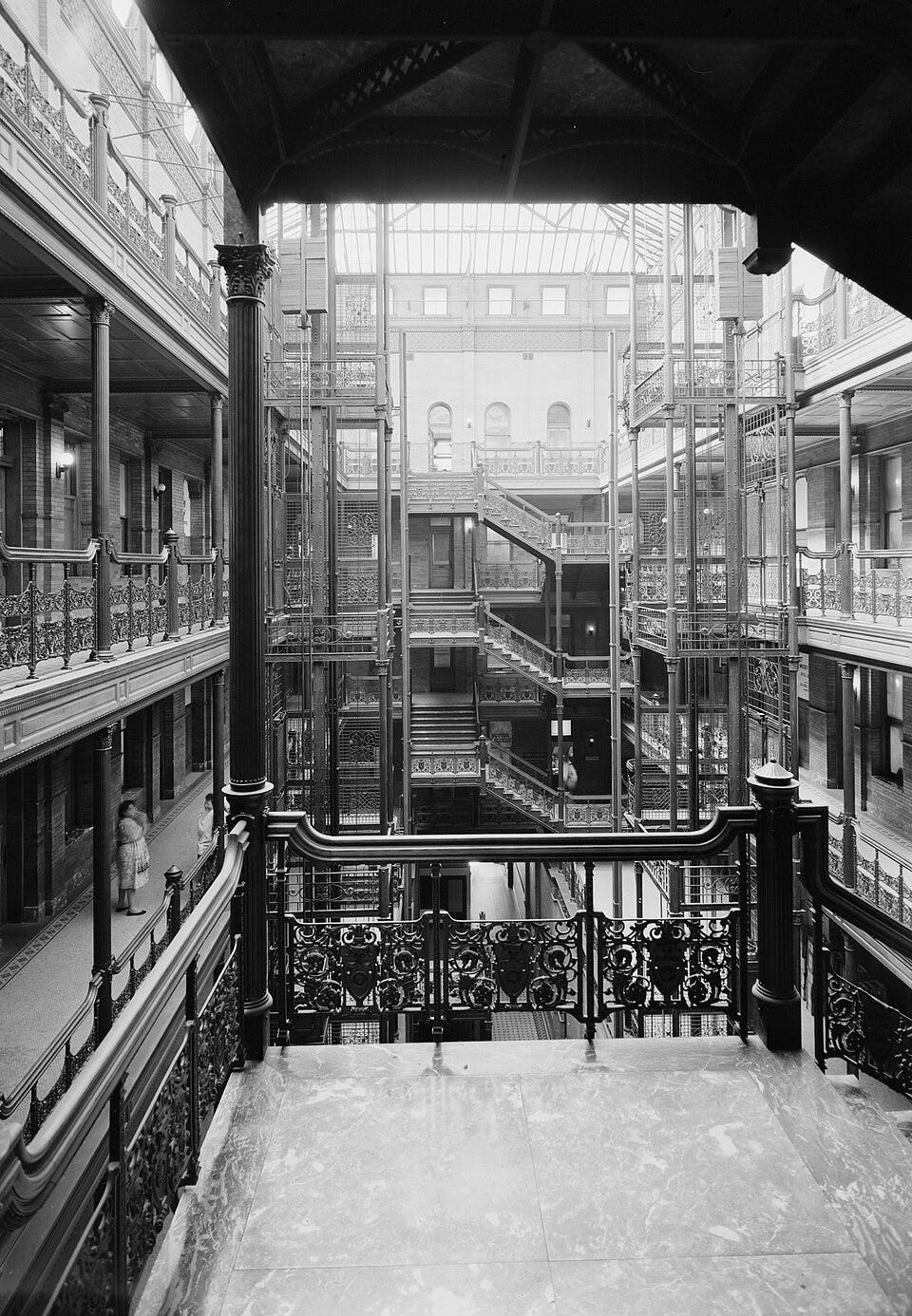
Z: The landscape itself feels so malleable. Everything can change at any time. Like the oldest buildings are, you know, from the 30’s and stuff. There is something mystical about it.
You can have a cynical book about New York and you can even have a cynical book about New York's weirdness. But I feel like nothing touches LA weirdness. There's just something like, the very fact that nobody's supposed to live there and everybody’s imported. This is a dream place, but we struggle to survive.
A: That's something that I think about all the time. I married a woman from here. My wife is from a blue-collar suburb. Her version of Los Angeles is so different than my own. She's from a Mexican family and it's very communal and not lonely. But I’m a transplant and so for me LA is this movie set that's always breathing down your neck, you know, and it's always kind of accusing you—of what? I don't know, but it's accusing you of something.
Z: The first word that comes to my mind when you say accusing is ‘fakery’. Everything feels so spread out and exposed. It's like you've got the interrogation lamp on you all the time. You know? It's like God is interrogating you.
A: Which is something that is happening in your novel, in a way. I know that it's about a man who's hearing voices and I know that a lot of it is autofiction, but it feels like it's getting at the soul of LA even for people who aren't having these sorts of intrusive thoughts. Somebody is judging you, but who is it!?4
Z: I remember going to parties where it always felt like we were having the conversation: “we should do something together.” Like, we should get together and brainstorm something. It was always kind of networky.
A: I’m not so cynical to say everybody's trying to get something out of you, because that's not the case, but everyone is working towards something in LA. People want to create, which is something I love about living here, but I also do need to recognize that most of my friends are either people I currently create art with or people I used to create art with. Without that, it can be hard to make connections.
Z: Yeah, that captioning job was a big thing for me as far as isolation.
[In the book, Zach’s main character works as a captioner for reality TV, working the graveyard shift. This is a detail he pulled from his own life.]
I felt kind of creatively stunted because I was always working on what I thought was gonna be my first novel. I was just so preoccupied by this depression that was settling onto me from the reality shows and all of that stuff. One episode of the Real Housewives Of… Anywhere, was like 43 minutes without commercials. That's the video that we got. And one episode would take an entire shift. So you're watching it in slow motion and constantly going back to hear them overlapping, yelling at each other because they wore the wrong color shoes to their seven-year-old's birthday party with the pony.
I’m supposedly writing a book, but I'm exhausted. I'm self-medicating because medical marijuana is a thing and I just …what am I?
I felt like everybody else was doing something here in Los Angeles, and I'm just going home and smoking pot and thinking about how I want to write something.
A: Right, it seems like everybody else is doing well and I'm the only one who's not. I don't feel that so much from my friends who live in other parts of the country or other parts of the world. They seem to judge themselves less.
That hasn’t pulled me away from LA. There are things that try to pull me away for sure, though. Every time I go to a city where you can walk, I always think, “fuck, I wanna live here”. And then I come back and something still grabs me. And I don't know what it is. I don't know if it's the weather. I don't know if it's the food or if it's that I still have hope. I can't run from the fact that it gives me hope that something will happen.
Is that a thing that you experienced while you lived here?
Z: Hope?
Well, that's kind of a joke. [The novel] Day of the Locust5 gave me hope when I read it, because it was like, “somebody else thinks this [city] is fucked up too”.
There's a specific chapter, where the character is walking through the backlot and just looking at the landscape changing around them and it's all facades; a city street or whatever and then that dissolves into a western ghost town and then that dissolves into whatever else, and behind all of that stuff is just two-by-fours propping the whole thing up.
[Captioning,] I had friends on the shift and everyone knew other people working on reality shows. We all knew, watching this stuff that the producers told them to say this, or they edited it such and such a way or that kind of thing. I think Day of the Locust gets at that because it's set in the Golden Age of Hollywood but also it's the Great Depression. We're having this extravagant party, but there's a dead horse in the swimming pool.
A: I understand what you mean about the unreality. It’s one of the isolating factors about living in LA. I often feel like we're extras in each other's movies. It's tough to find other people who are at least in the same world that you are and don't see you as a background extra.
Z: Ok, I wanted to ask you about you about being in LA. You said you couldn't put your finger on why you keep coming back. What's the biggest thing for you? Because it's trendy to hate LA. What’s the thing that leaps out to you that you love about it?
A: The people who you do find, who are in your movie, or you're in their movie at least, are all pretty wonderful. Me and those people, I feel like we all have our hands on the Ouija board planchette, all of the people that I love, and all of us wanna leave for some reason. But as we push, it all ends up back on ‘stay’.
He wants to leave because he wants to be close to his family and she wants to leave because she wants to buy a house and raise kids and I want to leave because I want to live in a city that I could walk in but none of us could ever leave for the same reason and there are just enough things that we all love that keep us here.
It is where I found a community and I've never had a community before. LA is aspirational and I'm in community with people who I aspire to maybe not be like, right? I used to do that. I don't do that as much anymore. Now I'm with people that I aspire to be with.
And the isolation makes it more necessary.
Z: If you suffer alone, then what are you doing there? You can suffer alone anywhere.
A: You engage with the other citizens of this city mostly in traffic. But that makes me think on why I like writing LA so much. Because it's so isolating, the places that aren't isolating feel like little oases in this traffic desert. It means that this weird little Thai place that you and your friend love has a magic of its own. The pleasant quirks of Los Angeles are these weird gathering spots where the freeways of our lives intersect and we get out of our cars and we engage with one another. Those places make me feel the type of happy you feel when you see an awkward kid at a school play having fun. I don't know if I can put a pin on why that is that way, but that's how I feel. Like, hey, look at you LA, being all cute.
Okay, we are getting close on time. Before I wrap up, is there something I should have asked that I haven't?
Z: Ooh, I don't know. I don't know. I was already kind of surprised that you approached me about this because I feel like I dialed back the ‘LA-ness’ of the book in a way. It's nice to know that I haven’t. I saw some crazy stuff when I was there and I feel like I didn't roast it in a way that I could have, but I didn't want that to become ‘the thing’. I didn't feel as resentful when I was writing [the book] as I did when I was living it.
I felt like I wanted to speak to the experience specifically. I didn't want to place blame on something specific. I didn't want to say LA was the reason this happened or reality TV, or medical marijuana… but I think none of those things helped. It's my personality. It's my chemistry. It's just who I am and I think I was either destined to have that happen no matter what or I would just kind of approach it in some kind of Zeno's paradox way—I’d always live with some kind of low-level anxiety for the rest of my life. But something catalyzed it, and thank God, because it forced me to reckon with it, and now I don't have that same burden anymore. I'm still socially anxious and stuff like that, and I still dwell on things, but I don't hear that same kind of critical voice in the same way.
I have to just accept the fact that I can't know other people's perceptive of me. And because even if I ask them, then it's like, well, I could be lying. You also can't zap into them and be in their skin. If you're still yourself, then you're not actually experiencing being someone else. So it's totally impossible. And like, well, that's terrifying, but I just have to live with it.
A: Are there any books set in LA that people need to read? You mentioned Day Of The Locust.
Zachary: I could do with revisiting Day of the Locust. I Love Raymond Chandler, too. Chandler's pretty great. Specifically, I really enjoyed The Lady in the Lake. And Vibes, Detective’s Agency6.
A: Never heard of it.
Z: Come on. It's like Scooby-Doo for grownups. It’s so fucking cool!
I thought, given the image and sort of the basic description, that it was gonna be a little more weird YA, to be honest. And when it starts at Burning Man, I was like, okay. Wait a minute—
A: This is about drugs and ennui. Thanks, man. That's kind of you to say. So everybody, my takeaways are these: LA is a complicated, weird, difficult, and lovely city, and also read both of our stuff.
So, before we go, readers, I thought I’d leave you all with a question. Do you have any books set in LA you think we all need to read? I’ll start.
Everybody Knows, by Jordan Harper. It’s a slick, no-frills modern-day noir doublehander about a former cop and a black-bag PR agent dealing with the seedy side of the starlet life.
How about you?
And finally, I want to give another huge thanks to Zach for sitting down with me, and reiterate again, again, and again that you really need to read I Hear You Watching.

Vibes will be back next week with a case you won’t want to miss, and what’s got to be my favorite of Diogo’s covers. If you’re not subscribed already, join the fun.
Though occasionally boring and suburban and occasionally terrifying for pedestrians, the coffee is excellent, access to Armenian bakeries unparalleled, and it’s one of the only neighborhoods in LA with wide, paved sidewalks.
I’m totally above that sort of thing. On another, unrelated topic, this is Piastri’s season. I’m sure of it. He’s got the car and the winning mindset and if you disagree you’re my enemy.
One of my favorite sections of the novel. Who’d have thought a man alone in his apartment talking to voices in his head could be so riveting.
Another of my favorite chapters. Just a man in a grocery store sure he’s being observed and observing himself being observed and observing himself observing himself…
The Day of The Locust , a 1939 novel from Nathaniel West about the Golden Age of Hollywood.
A series of episodic shorts that follow two mid-thirties friends—a mathematician and a mystic—as they try to recapture the joy and freedom of their mid-to-late twenties by becoming nominally successful ghost hunters. Writer Alex Shifman has said he wrote most of it “really fucking high during peek COVID”.
Critics have called it, “a shoddy Board to Death ripoff”, “equal parts pretentious and vapid”, and “actually pretty good!”.
 | A guest post by
|
Wide side walks that police DON'T expect you to be walking on ... absolutely (barking) mad.
Love from London.